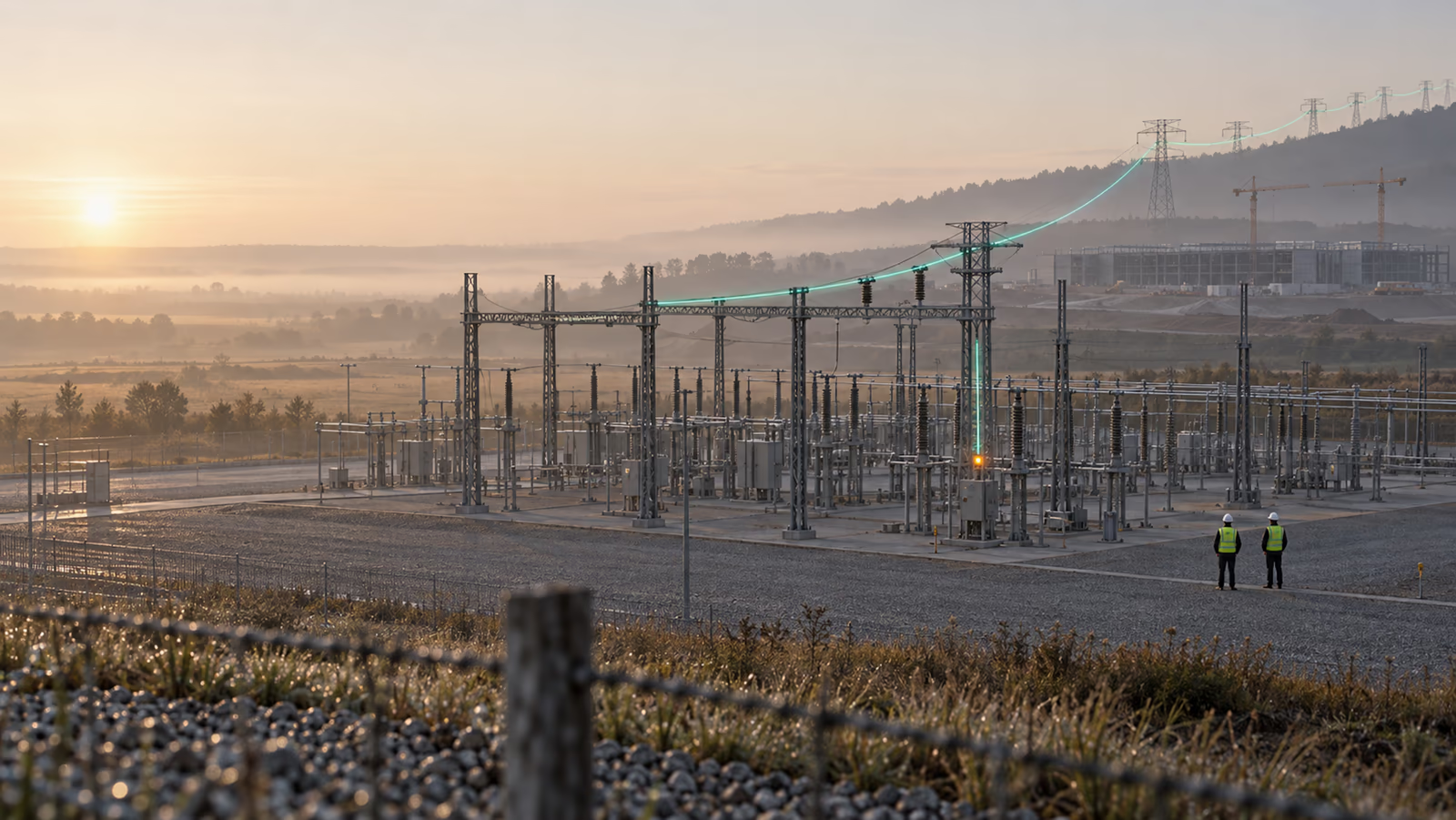
A request lands on a Tuesday. A utility needs a scope for a new interconnection serving a data center campus, and it needs it by Friday.
Your firm has done almost exactly this job twice. The engineer who led both is on a site three states away and booked through the quarter.
So the scope gets written by whoever is free, from whatever they can find, with two phone calls to the engineer who led the last two. It goes out on time. It is also a guess, and everyone who touched it knows it.
Nobody would call that a staffing problem. The firm had the people. It just could not reach what they knew without stopping one of them.
That is the problem the AI buildout is exposing in engineering firms, and it is being misfiled. It looks like a shortage of engineers. It is actually a shortage of recall: how fast a firm can scope work it has already done, when the person who did it is busy.
It is the same gap as the difference between people getting faster and firms getting better, arriving this time with a deadline attached.
What are firms in the data center market actually saying?
ENR's 2026 Top 500 Design Firms report, published in April, puts the list's 2025 design revenue up 7.4 percent to $158.7 billion. Only two markets grew by double digits: telecommunications, which ENR describes as driven by data centers, up 31.3 percent, and power, up 14.6 percent.
Read the executives rather than the totals and the story changes. Doug Jaeger, president and CEO of Ulteig, told ENR the surge "creates opportunity while tightening capacity, especially for specialized talent and teams that can move quickly without sacrificing quality."
He also described how the work arrives: "Unlike traditional utility capital investment programs planned over longer horizons, data center work can arrive with more urgency and less certainty around scope and timing."
Rod J. Sommer, CEO of LJB Inc., put the general version plainly: "The industry is being pushed to do more with fewer people." In ENR's August ranking of international design firms, Archetype Group CEO Pierre-Jean Malgouyres went further about the global market: "Clients are choosing partners based on who has that depth."
Not everyone feels it. Michael P. Sheerin, CEO of TLC Engineering Solutions, told ENR the surge "hasn't affected how or where we win work as much as it has affected the capacities" of the contractors his firm relies on.
Take that seriously. The strain is not landing everywhere, and where it lands is the clue.
Why is this a memory problem and not a staffing problem?
Put Jaeger's two sentences together. Scope arrives uncertain, and the people who can resolve it are scarce. A firm resolves uncertain scope from what it has done before: the last interconnection, the last campus, the last time a client changed its mind in week three.
Where that knowledge lives decides everything. If it lives in the firm's record, anyone scoping the job can reach it. If it lives with the specialist, the specialist is the capacity ceiling, and every new request queues behind one calendar.
That is why the pressure lands so unevenly. Two firms can employ the same number of specialists and feel this market completely differently. The difference is not how many experts they have. It is whether their expertise is available to anyone but the expert.
Hiring does not close that gap on its own. A new senior engineer adds one more person who knows things. It does not make what the firm already knows reachable, and specialists are exactly the people this market is short of.
This is the distinction that matters. A specialist's knowledge is a personal asset the firm rents by the hour. The same knowledge, captured in a record the firm can query, is organizational: it stays when the specialist is on another site, and it is still there after they retire.
Concentrate it in a few people and you have built a queue, not an advantage.
What if your firm has no data center clients?
Plenty of firms reading this will never design a data center campus. The test Jaeger describes is not specific to them. Any work that arrives faster than it can be scoped runs it: an emergency repair, an on-call task order, a program that moves up a year on a funding decision.
The data center market simply runs the test hardest, and in public. That is useful, because it shows the failure before your own clients hand you a Friday deadline.
Most firms have not fixed this because they have been solving the wrong problem. They count engineers. The constraint is how many of those engineers have to be interrupted before the firm can answer.
Headcount has a line in every budget, so it gets managed. Recall has no line anywhere. Nobody owns how long it takes the firm to find out what it already knows, so nobody is measured on it, and the answer stays in project folders, old email and the calendars of the people who did the work.
Where do you start?
Pick one kind of job your firm would quote again tomorrow. Take the last three you delivered. Then ask how long it would take someone who worked on none of them to scope the fourth, without interrupting anyone who did.
Where the honest answer is that they would have to call someone, you have found the constraint. Write down each call. That list is the start of a Workflow Analysis: one workflow defined end to end, because nothing can run a workflow nobody can describe.
Then take the call that happens most often and ask what it would take for the answer to exist without it. That is not a technology decision yet. It is a decision about where the truth about that job lives.
The data center boom will cool, or it will not. Either way, the request that lands on a Tuesday with a Friday deadline is not going away, and it will keep landing on the firms whose best people are already booked. The firm that can answer it without an interruption quotes first.
The question for your next leadership meeting is not how many specialists you need. It is how many of them you have to interrupt to answer.
Where to go next: an AI Workstream takes three to five weeks, defines one workflow end to end, and ends with a scoped recommendation for what to build. The fee is credited toward the engagement it recommends.
Sources
- ENR, ENR 2026 Top 500 Design Firms: AI Boom Buoys Design Revenue, by Emell D. Adolphus and Jonathan Keller, April 22, 2026. Revenue figures are ENR's, compiled from data firms submitted to its survey; quotations are the named executives'. enr.com
- ENR, 2026 ENR Top 225 International Design Firms: AI Boom Lifts Global Design Needs, by Emell D. Adolphus and Jonathan Keller, August 5, 2026. The Top 225 ranks firms on design revenue earned outside their home country. enr.com
None of the firms quoted here has any relationship with Universal Mind or UniversalContext.